


Descrizione
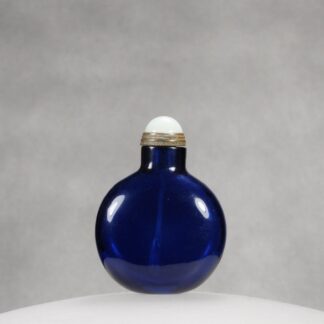
Description: Chinese ruby red glass snuff bottle of plain, rounded flattened shape. The technique of production of ruby red glass, based on the use of colloidal gold, was introduced by the Jesuit missionaries at the Imperial glassworks during the Kangxi reign. Snuff bottles of this color were produced along 18th and 19th centuries, and we have a few in our collection. What makes this bottle a case apart from them, is the fact that it was carved out from a solid block of glass, instead of being just blown. The picture #8 is showing a detail of the bottle, where it can be appreciated the rough surface of the inside of the bottle, due to carving. As explained in the Description of our snuff bottle G37, bottles carved out from solid blocks of glass are rare and they are usually made that way with the intention of imitating bottles carved out from precious stones, like aquamarine, tourmaline, etc. Talking about glass on his site, Robert Hall say:
“Although most glass bottles were blown, usually into a mold, many early bottles were carved from a solid piece of glass. The carving of glass blocks as if they were hardstones was a common alternative to blowing the vessels, and often reserved for glass imitating precious stones, such as aquamarine, amethyst and beryl.”
In fact, the few bottles carved out from solid blocks of glass, that we are aware of, are light blue, or green or yellow color. Our bottle is the only case at our knowledge of ruby color, which makes this bottle very rare. In the Foreword of the Marakovic collection, that includes three bottles carved from solid blocks of glass, Hugh Moss says that “ruby-red glass was an imperial colour (at the beginning of the 18th century)” and that “By the nineteenth century, ruby red was being freely used elsewhere.”
Another interesting feature of this bottle is that the base is plugged, i.e. it is a separate piece. This is shown in the pictures #9 and #10. The picture #10, taken through the mouth, is showing that the base is protruding inside the bottle. We have another bottle with this feature, the small jade bottle S8. We wondered why this opening in the base of the bottle. At first glance, one would think that it was made on purpose to facilitate the hollowing. But it must be noted that the thickness of the glass at the shoulders is greater than that in the lower part of the bottle (see picture #11 taken in backlight), as normally happens in the hollowing of stone bottles, being the hollowing made through the mouth and thus the shoulders are not easily reached. So one should assume that the base of the bottle was accidentally damaged during the operation of hollowing, which can happen, as for example happened with our Jade bottle S8. But if this were the case, why not logically take advantage of the more comfortable and wider opening of the base to improve the carving at the shoulders? Our conclusion is that we have here an example of imitation taken to the extreme, that is, a glass bottle that imitates a stone bottle that was damaged during the hollowing. Thus, all its typical features are reproduced, such as the greater thickness at the shoulders and the repair base inserted. A further reason to support our conclusion is given by the fact that the bottle is imitating a gem stone of exceptional preciousness given its purity and size, so not easily discarded and thus the “repair of the damage” is highly justified. Another advantage of the plugged base is that, being it carved out from a plain sheet of glass, there are not the typical swirls of blown glass bottles, which are the usual key for identifying a glass bottle imitating other materials.
Mark: No marks
Foot/base: Plugged flat base and rounded foot
Dating: 18th century
Material: Ruby red glass
Size: 56 mm high
Stopper: Greenish nephrite jade with silver collar and spoon
Provenance: Antiquarian market
References: See bottles carved out from solid blocks of glass sold by the major auction houses and in the Marakovic collection, although none of them is of ruby red color.
Notes: The penultimate picture is showing an unusual bottle carved out from a solid block of glass, sold at an exceptional high price by Bonhams. That bottle is highly unusual being carved outside. It is here because of the related Notes of the auction house, mentioning that in the 18th century, jade carvers were employed at the Imperial workshop for carving glass, including glass bottles. The last picture is showing a peach shaped bottle carved out from a real ruby stone. As all the few snuff bottles of real ruby, the stone is not pure because of the size. Pure ruby gems are found in small sizes.


Recensioni
Ancora non ci sono recensioni.