


Descrizione
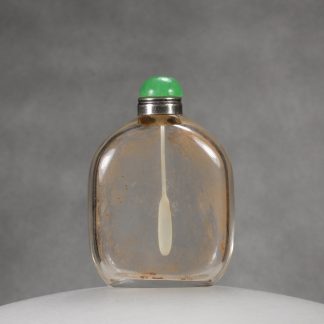
Description: Chinese bubble-suffused blue glass snuff bottle of flattened ovoid form, with incised a poem by the Tang dynasty poet Wei Yingwu, who wrote this to a colleague while travelling on a boat to the Yellow River. The poem is as follows:
夹水苍山路向东,东南山豁大河通。
寒树依微远天外,夕阳明灭乱流中。
孤村几岁临伊岸,一雁初晴下朔风。
为报洛桥游宦侣,扁舟不系与心同。
In the poem, he described the scenery he saw on his journey. It could be translated as:
“The stream that came from the lust green mountain travel eastwards / it makes a turn towards the South east and join the main tributary / On the far horizon, you can see the trees, tiny because of the distance / The sun ray lost its brightness within the turbulent flow of the river / At the bank of the river are small villages that no one know their age / A goose flew against the prevailing wind / A loving official couple visit the Luo Yang Bridge (in a small boat) to pay their respect / The boat was not tied and flow along the river as the wave and their heart wishes.”
The inscription is including “Qianlong, second Spring’s Month, Jia Wu (1774)”.
This is a bottle of very high quality. The old glass of rare old color tone, the shape, finishing and the quality of the carving are all supporting the veracity of the incised date and mark.
Foot/base: Tall foot and flat base
Mark: No marks on the base
Dating: 1774, Imperial, from the Palace Workshops, Beijing
Material: Glass.
Size: 70 mm high
Stopper: Coral with well-shaped ivory spoon, original. Note: the original spoon, which were exactly identical to this one, had to be removed for sending the bottle to USA. Later, the collector Joseph Baruch Silver gave me this spoon, who he had to remove for the same reason from an Imperial Qianlong bottle. This lucky opportunity allowed me to restore the stopper/spoon assembly as it was originally.
Provenance: Purchased on February 23, 2017 directly from Mr. Carlo Venegoni of Milan.
Mr. Carlo Venegoni is a well-established international architect, of a traditional family of art lovers. He born in 1944. He inherited the bottle from his grandfather, Aldo Venegoni, painter of the school of Remo Pasetto (1925). Aldo Venegoni was passionate about exotic art, especially Oriental. The bottles here coming from this collection are: G25, G45, G34, O19, O20
References:
Notes: After the two pictures showing the whole inscription of the bottle, we can see here some pictures which are related to another bottle. The reason for those pictures being here is to better explain how to look at a genuine bottle of the Qianlong period, and of Imperial quality; how to correctly judge what is genuinely antique and what is not. Thus, the bottle seen in those pictures is here for comparison/reference purposes.
But let first talk about the provenance of our bottle. As said above, I purchased it, together with the Shagreen double bottle O20 and the wood snuff dish O18 (see Organic bottles’ section) directly from Mr. Carlo Venegoni. We become friends; he introduced me among a group of Japanese Art lovers in Milano. Despite the many contacts that we had, we never talk about the provenance of the bottle. It was mentioned only after several months, when he visited me and he saw the bottle in the display vitrine; then he said that he was regretting of having had to sell it (that has been because he was in a seriously bad situation due to not paying customers of his professional activity, and that is absolutely true, as I was already aware of that), because that bottle was remembering his childhood. And then he told me about his grandfather, who had a sort of Wunderkammer; he remember of having seen there this bottle since he was a boy. Because all this was said spontaneously, having not been asked about that, and because of how I know him, I see no reason at all for not believing him.
Back to the bottle. This is the opinion expressed by a great, worldwide well known and long-time collector, who has imperial bottles in his own collection and has handled many, including the bottle taken here as reference. When he directly handled our bottle, he said: “I can categorically attest that yours is genuinely Qianlong, Palace Workshops, and I am referring to both the bottle and the incised inscription”.
In his opinion, the bottle taken as reference could be 18th century, but the inscription is surely later, and when he told me that, I was already of the same opinion because of the following.
That bottle has been sold at an auction. It is a smoky quartz bottle belonging from the famous Bloch collection. Like our one, it bears a poem and the same “Qianlong, second Spring’s Month, Jia Wu (1774)” date.
The next steps may be of interest to other collectors. Note that the last group of pictures are identified by Pic. 1, Pic. 2 and so on until Pic. 9. Please refer to that group and to the last picture when reading the following:
To start with, have a look at Pic. 1 where both bottles are compared, in the same scaled ratio size. We see that despite being the reference bottle smaller, the inscriptions are taking the same footprint size. Nevertheless, the characters on our bottle are smaller (larger spacing between characters), the strokes are thinner; all in all, a much fine and precise incising work.
If we go in detail, we can see that comparing the quality of the characters is like comparing elegance with sloppiness, see Pic. 2 and Pic. 3.
Another point that must be considered is the red filling of the incised characters, that was the norm at that time. The Pic. 4 is showing the red filling of the Bloch’s bottle, that an observer would call it as a nice red. But the Pic. 5 is showing the red of our bottle. That is the expected red on an item that is carrying 200 years on its back! Regardless the nature of the substrate, being it wood, canvas, or else. That is the red that here in Europe is seen on wood works and paintings of the 18th century or earlier, for example in Churches, unless they have been restored. The red on Bloch’s bottle, in my personal experience with paintings and furniture restoration, is there since no more than a few decades, in my opinion.
Let see what is even more determinant. There are some clear features which are revealing at first glance if an incised inscription has been made by means of a hand-held chisel/cutter or by means of a modern rotating grinder, similar to those used by dentists. One of these features is that either the end and the beginning of an incised stroke is rounded when made by a rotating grinder, while sudden stepped ends of a stroke are only possible by a hand maneuvered chisel. Besides that, the variation of width of a stroke when made by a rotating tool is made by multiple, divergent strokes; it looks really different from that carved by a chisel. The tool’s tracks in a grinded stroke are parallel to the stroke, while those left by a chisel are either parallel or non-parallel. Strokes incised by a chisel have a V shaped cross section, with sharp angled bottom. The bottom is crisp because of the multiple takes of the chisel, while the bottom of a grinded stroke is smooth, compared to it. These features are unfortunately not well shown in pictures because of the bidimensional view, where the deepness can’t be appreciated. Pic. 6 and Pic. 7 are trying to show these points, but must be “interpreted”. At a direct inspection, these features are evident.
Look at the multiple details highlighted by the yellow arrows in Pic. 8. Those are “off-shots”, clear tracks of an unprecise handling of a rotating grinder. The operator has involuntarily touched with the grinder the surface of the bottle in misplaced areas. It is known that fast-cutting tools and abrasives leave tell-tale marks and often produce sloppy work and over-shooting of lines. This undoubtedly proves that the bottle has been grinded with a modern tool. And not very well, I would say. Compare with the cleanness of Pic. 9, where you can note: none of those off-shots, well-patinated surface, smoothed edges of the strokes due to wear, many stepped ends of the strokes. THAT is how must be the look of a hand incised bottle!
And, very important, a further point: what is really difficult, almost impossible to artificially reproduce, is the natural patina of old objects. A trained eye can’t fail in judging this point. In Pic. 9 you can appreciate the natural surface wear, the edges of the incised strokes smoothed by natural wear from handling. Compare with the surface of the other bottle, in the last picture: perfectly shining, immaculate. By naked eye that is enough for telling what is genuinely antique and what is not.
Conclusion: The description of Bloch’s bottle says that “This unusually small bottle is of a popular mid-Qing form that occurs in a wide variety of materials, and adds weight to the probability that it may have been an imperial group. (……here other examples with this form are mentioned……..) To whatever extent the form is a fairly obvious one that could have been made elsewhere, it seems likely that it was also a standard imperial form made at court workshops. The large number of plain examples of the form may also fit in with the giving of presents on regular occasions from the court to officials and other dignitaries. To provide quantities of plain bottles would have been easier and quicker than providing bottles carved with specific subjects.” Well, frankly that sounds like putting hands forward to prevent unwanted rising of dubious, in our opinion. We do not think that the plain shape is a good argument for believing that a bottle could be imperial. Our attribution belongs from all the points exposed: the old glass, the quality of either the glass, the shape, color, finishing, quality of the inscription and how it has been made, how the carving has been carried out. At our knowledge, it is not known a bottle of this type that could be dated to the 19th century; either they are of the period or they are much later. Then for deserving an imperial attribution a bottle must be old, and after that, quality and carving method matters, as in this case.
A further conclusion is that not always Provenance is deserving the consideration that seems becoming a must in evaluating snuff bottles. It is not proven that a collector is also necessarily competent. If taken with the due ponderation, an honest provenance may worth much more than a provenance belonging from collection X or Y. The reference bottle mentioned here is a clear example: top Auction house, top collection provenance, handled by top dealers, sold at high price, and nevertheless clearly a much later copy.
Then dear collector, believe in your brain. Do not take for grant that a bottle is a valuable one only because it is belonging from a big name’s collection. And keep in mind that you, as collector, are interested in correctly judging an item for the only love/appreciation of it, not biased by commercial reasons; which may not be exactly said for all experts.
We hope that this lengthy essay will be of some help to other collectors for correctly judging a bottle of this type.


Recensioni
Ancora non ci sono recensioni.