




Descrizione
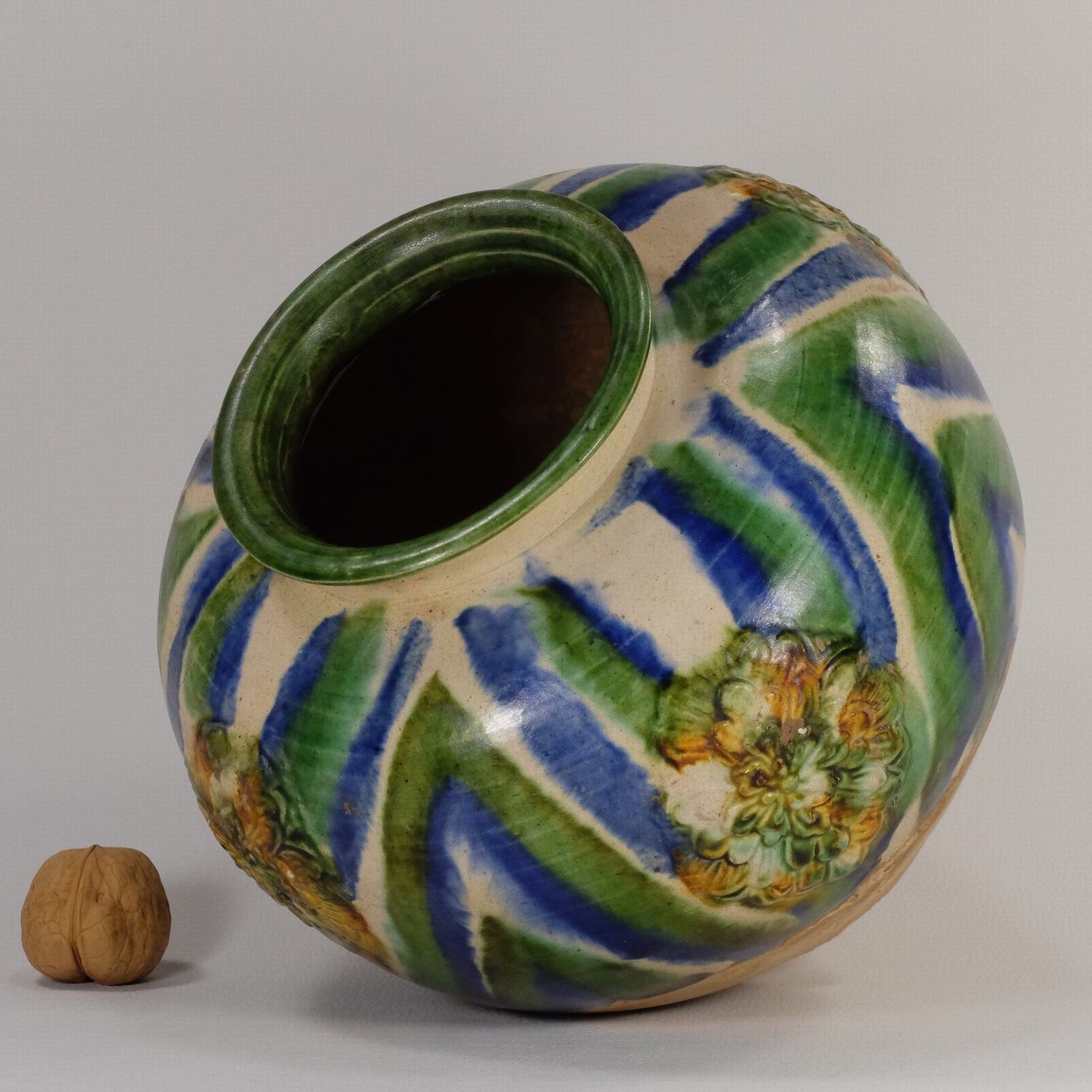
Description: Chinese Tang dynasty guan jar, with applied four floral medallions molded in light relief, and glazed overall in abstract pattern with sancai and blue glazes.
Sancai (literally, three colors), a low fired lead glaze, is one of the great achievements of Tang potters. It is known that besides the classical three colors (green, brown, white) other colors too was seldom used. Among them, the blue which was obtained by adding imported cobalt, was therefore more expensive and used sparingly, often on smal pieces. Hence, the blue is rarely seen on big Tang sancai glazed jars. Of the last eight pictures, the first one is showing a jar with the same pattern, but missing the blue, that was in the now dispersed Corrado Zingone collection (we have in our collection a tea caddy from Zingone’s collection, see QP21 in the Early Qing section). The second picture is showing a much smaller, blue glazed Tang jar in the collection of the Xi-An Municipal museum, and the third one is comparing the cobalt blue tone of that jar with the blue of our one. Even rarer than the presence of the blue, are sancai jars with applied floral medallions in low relief. Then the fourth picture is showing a jar with a scarce use of blue, and the fifth and sixth pictures are showing a small and a big jar with the applied medallions. Our jar is at the moment the only one that we have seen, sharing both features together, which makes it extremely rare. The last two pictures are of the thermoluminescence test of out jar.
Dating: Tang Dynasty (618 – 907 AD). Because of having two rare features combined on a single jar, we decided to submit it to a thermoluminescence test (*see a personal note here below), which has been performed by the Arcadia Lab in Milano. It is a very reliable Lab., the scientific responsible being Prof. Marco Martini, an authority in the field. He has supervised the implementation of the TL test Laboratory in Xi-An. He is managing the World Congress for Archaeometry for the Mediterranean area and is the Author of many publications related with TL technology. Thanks to the wide mouth opening of the jar, it has been possible to take the test samples from inside the jar, so the outside has been preserved intact. Three samples have been taken, one on the base, one in correspondence of a medallion, and one toward the upper part of the jar. The test confirmed the authenticity of the jar. In order to exclude the possibility that, despite the previous cleaning, the sample material could have been contaminated by the surface of the ceramic, we did ask to repeat the test, taking the samples through the same previous holes, so to take the material from the core of the ceramic only. The test resulted positive again. Then we had a talk with prof. Martini who confirmed that he has no doubts about the authenticity of the jar, based on the results and on his own experience. The last two pictures are showing the TL test certificate.
*A personal note from the collector. I am sure that by reading that the TL test was performed by a Laboratory situated in Italy, many would turn up their noses. Aside from the different opinions about the reliability of the thermoluminescence test itself as a method of dating, we explained above who is managing that Laboratory, sure one of the maximum authorities in the World. I am sure that most of those who would turn up their nose are instead blind trusting (I know that from direct experience) a famous laboratory who even does not provide any data in their certificates. It is like paying for a medical test and receiving a result that says “you’re healthy, don’t worry” or “there are problems”, which is useless in my opinion.
Size: 19.5 cm high
Provenance: Bought in 2016 at a local Antique Fair. The guy who sold it had no idea about the age of the jar. He only said that he bought it from an old Engineer who was working in the Petrol inspection field, and who was working in China 20 or 30 years before. But he didn’t know where or how the man purchased the jar.
References: Please read the description.
Notes: From Wikipedia and various sources:
The Tang dynasty (Chinese: 唐朝), or Tang Empire, was an imperial dynasty of China that ruled from 618 to 907 AD, with an interregnum between 690 and 705. It was preceded by the Sui dynasty and followed by the Five Dynasties and Ten Kingdoms period. Historians generally regard the Tang as a high point in Chinese civilization, and a golden age of cosmopolitan culture. Tang territory, acquired through the military campaigns of its early rulers, rivaled that of the Han dynasty. After 300 years of division and fragmentation following the collapse of the Han dynasty in 220 A.D., China was once again unified under the Sui dynasty (581–618). The political and governmental institutions established during this brief period lay the foundation for the growth and prosperity of the succeeding Tang dynasty. Marked by strong and benevolent rule, successful diplomatic relationships, economic expansion, and a cultural efflorescence of cosmopolitan style, Tang China emerged as one of the greatest empires in the medieval world. Merchants, clerics, and envoys from India, Persia, Arabia, Syria, Korea, and Japan thronged the streets of Chang’an, the capital, and foreign tongues were a common part of daily life.
Tang dynasty stimulated a cultural and artistic flowering that amounted to a golden age. Like most dynasties, It rose in duplicity and murder, and it subsided into a kind of anarchy. But at its apex, in the early 8th century, the splendor of its arts and its cultural milieu made it a model for the world.


Recensioni
Ancora non ci sono recensioni.